

On October 29 and 30, the Kursaal Conference Center in Donostia hosted a new edition of the NovaGob 2026 Conference. The event was marked by a shared priority in the public sector: translating the potential of artificial intelligence in public administration into operational, secure, and measurable solutions for local government.
Over the course of two intense days, ONode actively participated in the official program through three different formats—an agile challenge, a technical demonstration session, and a panel discussion. Ten days after the event concluded, we’re sharing this summary and assessment of NovaGob 2026, with clear lessons on where govtech innovation is headed when grounded in real-world processes and sound principles.
The Challenge in 10 Minutes: Transparency Portals Can No Longer Be Static Repositories
Under the title “Reinventing the Transparency Portal: Process Automation, Data Governance, and Smart Information Search,” we issued a direct call to action regarding how active disclosure has been managed over the past decade.
- The crux of the debate: Municipal transparency can no longer rely on periodic manual tasks that overwhelm administrative offices and IT or transparency departments, nor can it simply amount to a repository of PDFs that are incomprehensible to the public.
-
The conclusion: A transparency portal powered by artificial intelligence requires direct connection to official data sources, the automation of regulatory obligations, and the replacement of rigid search engines with natural language interfaces. Accountability is only genuine if the data is accessible both to auditors and to local residents.

The demo session: “Are you still doing this by hand?”
In the practical demo room, we showcased the operational impact of two of our main tools: Lúcida (a Unified Transparency Portal with Artificial Intelligence) and Zero (a Document Anonymisation Platform with Artificial Intelligence).
- The key takeaway: Putting real figures and workflows to two tasks that traditionally consume weeks of technical work: the structured publication of statutory obligations and the anonymisation of administrative files under GDPRbefore their public release.
- The conclusion: The value of AI applied to public administration is not measured by the complexity of the model, but by the hours it frees up at the end of the week. When the software takes on metadata extraction, record synchronisation and document triage under technical supervision, public sector staff regain the control and time needed to resolve substantive issues.
The Round Table: The Voice of Those Who Manage the Territory
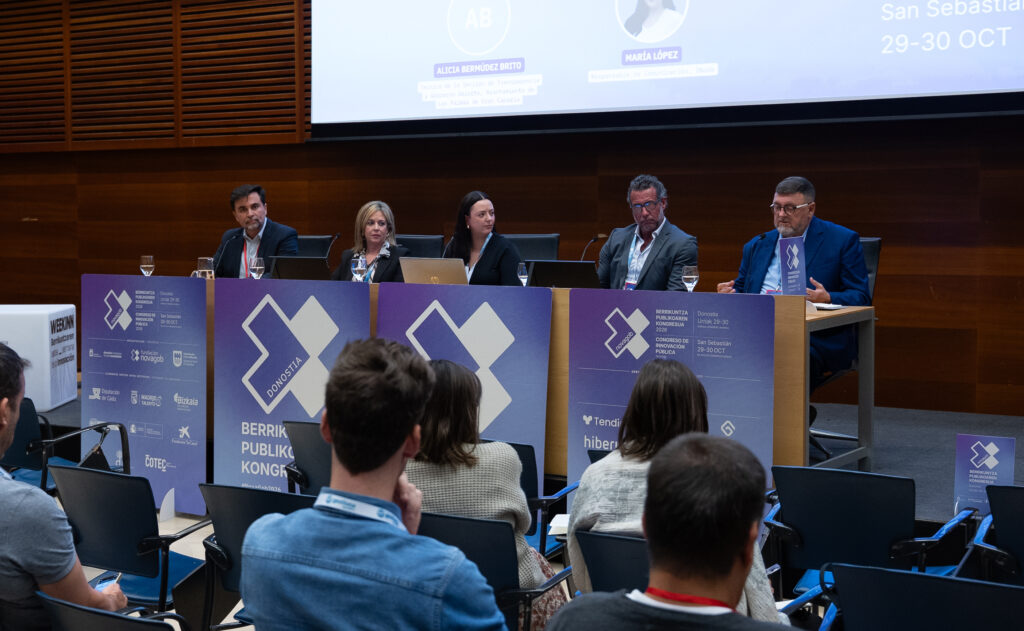
On Friday, the Discovery Room hosted the NovaGob 2026 panel discussion: “Beyond Accountability: Practical Experiences of an Automated, AI-Powered Transparency Portal Centred on Data Governance”.
The panel brought together complementary profiles who live the challenges of local and provincial public management on a daily basis:
- Clemente Barreto, Head of the Digital Transformation Area of the Cabildo of Tenerife.
- Jose Gabriel Piera, Secretary-Controller of Navarrés Town Council.
- Juan Bonmatí, Director of the Municipal ICT and Digitalisation Department of Alfafar Town Council.
- Alicia Bermúdez Brito, Officer in the Transparency and Open Government Section of Las Palmas de Gran Canaria Town Council.
The panel’s conclusion: Regardless of an entity’s size—from an inland municipality to a large city council or an island council—the success of digital transformation in local authorities lies in organisational rigour. To automate transparency, you must first organise the internal governance of data. When this legal and technical foundation is in place, AI ceases to be an isolated proof of concept and becomes an infrastructure that streamlines internal management and legitimises the institutional relationship with citizens.
Three key lessons from NovaGob 2026
Looking at the conference as a whole, three ideas have set the pace for the discussions and conclusions in Donostia:
- Technology that adds steps doesn’t modernise; it clogs up the system. Any project that adds bureaucracy or requires technical staff to spend more time feeding the tool than resolving the case is bound to be rejected. True innovation begins with redesigning and simplifying the workflow.
- Growth and sustainability from values.Not everything goes when it comes to digitalisation. The administrations that are advancing with greater soundness are those that integrate ethical safeguards from the design stage: strict anonymisation under the GDPR, data traceability and technological sovereignty in the face of opaque solutions.
- Human judgement at the centre. In contrast to dehumanised visions of automation, the consensus in the public sector is unequivocal: algorithms process, organise and accelerate; public officials decide.
We return from the NovaGob 2026 Congress with a strengthened conviction: today’s public administration demands specialised, robust tools, specifically designed to give back valuable time to the people who run our institutions every day.
